
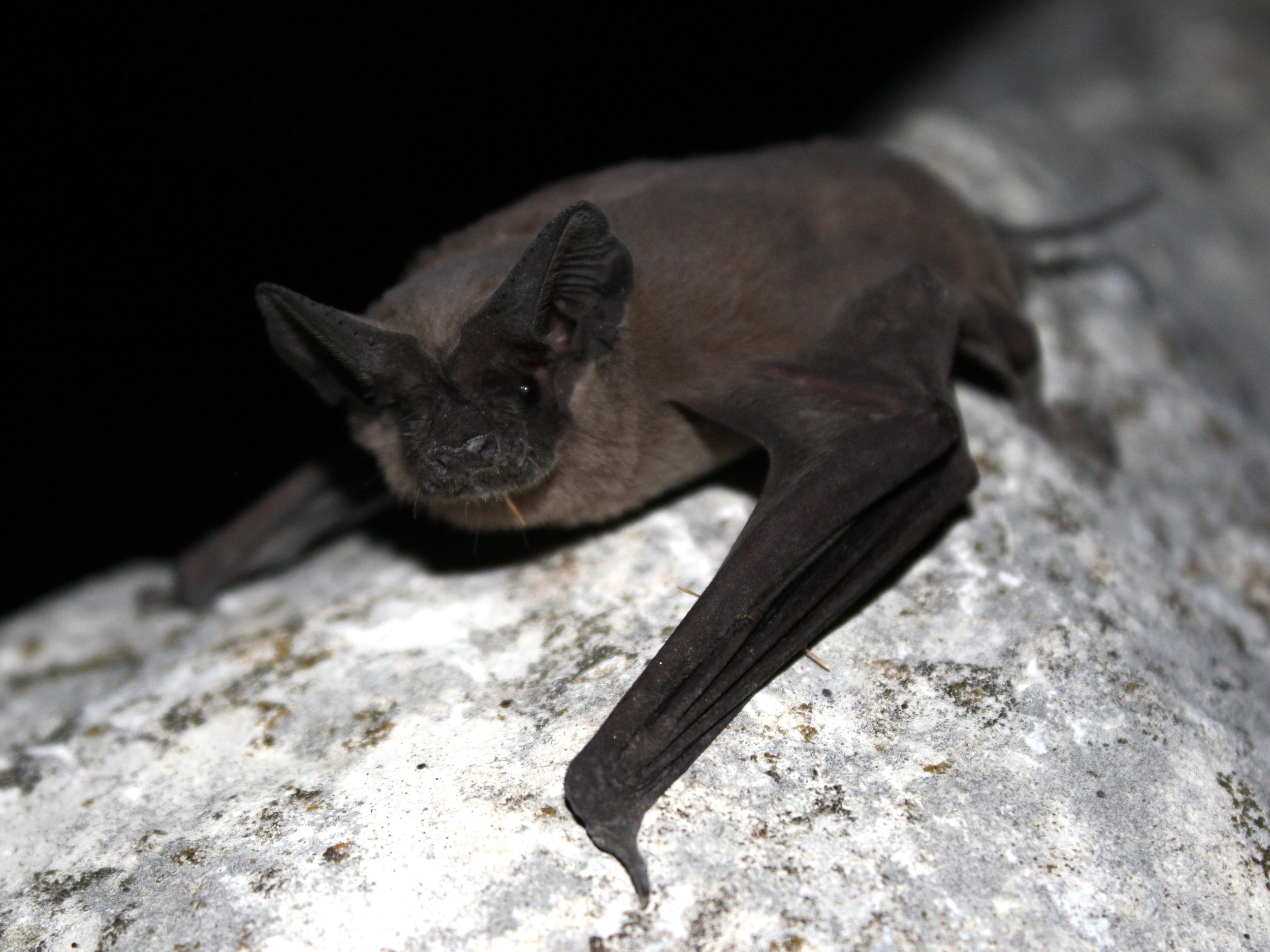
Header image depicts a Mexican free-tailed bat.
Every October, bats get cast as a Halloween fright: flapping out of haunted belfries, tangling in hair, hunting for necks to bite. But their real role is a lot less scary and much more useful.
Bat Week runs every year from October 24 to 31, right alongside Halloween, to celebrate bats and the big jobs they do for our ecosystems. Additionally, CFC recently had the opportunity, thanks to funding from the CDFW CRGP, to attend the Bat Ecology & Field Techniques workshop organized by The Western Section of The Wildlife Society (TWS WS) at the Angelo Coast Range Reserve in Mendocino, CA. What we learned will help CFC adopt minimization strategies so that, when doing construction, we better understand if bats are present and, if they are, how to limit our disturbance.
So in the spirit of the season and sharing our experience, we're handing out a little trick-or-treat: first we'll bust a few spooky bat myths (the tricks), then share some of our favorite bat facts (the treats), and finish with why bats are some of the best friends a farmer, gardener, or land steward could have!
Tricks: 5 Bat Myths, Busted
1) "Blind as a bat"
Bats can see just fine. According to the USGS, most bats have small but very sensitive eyes (some species like the fruit bat actually have quite large eyes) that work in light levels we'd call pitch black. On top of that, many bats use echolocation: they send out high-pitched calls and listen for the echoes to "see" with sound.
In order to get even close to seeing like a bat and spot them in the dark, we employed the use of night vision goggles at the workshop.
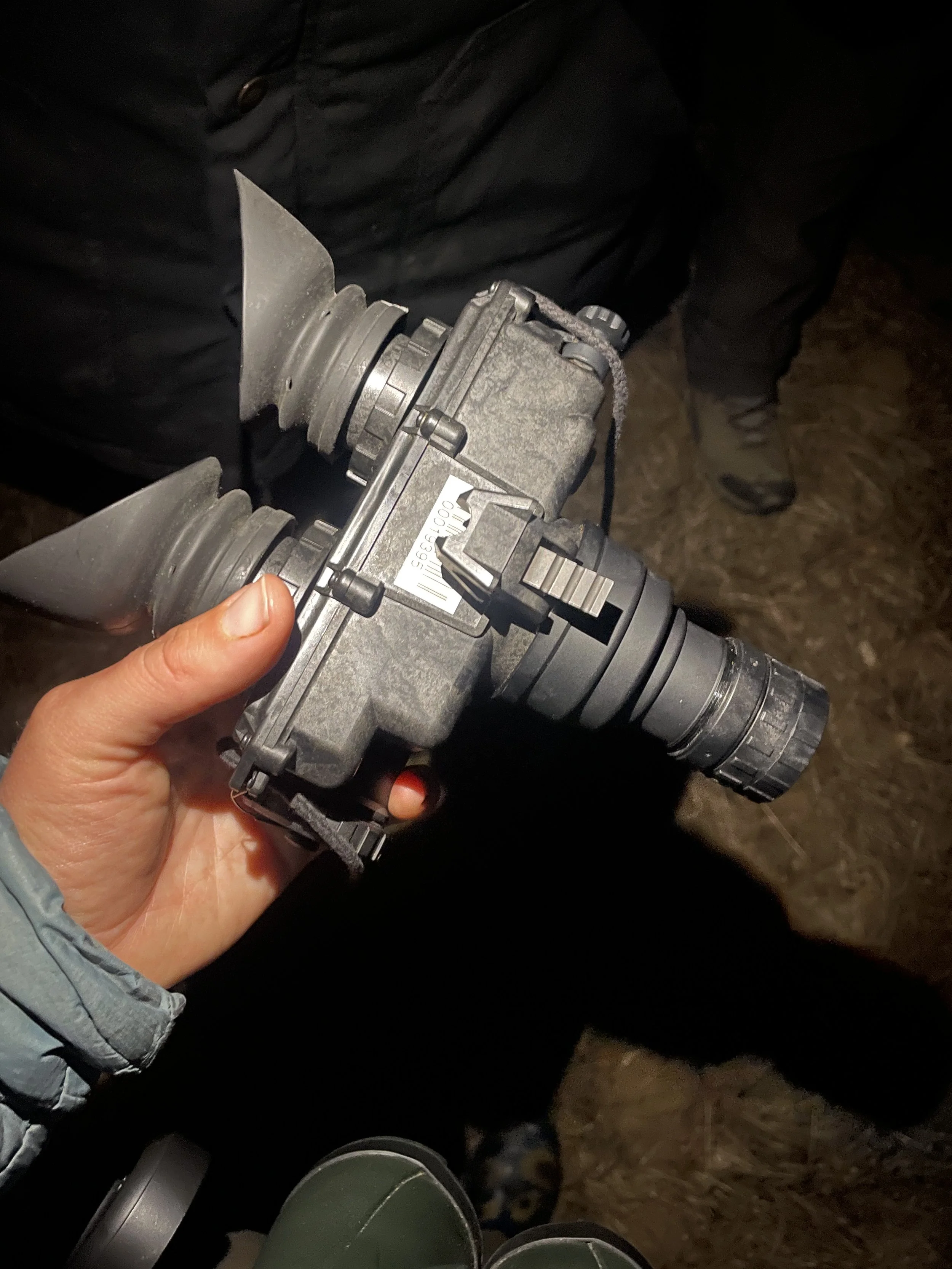
Night vision goggles from the top.
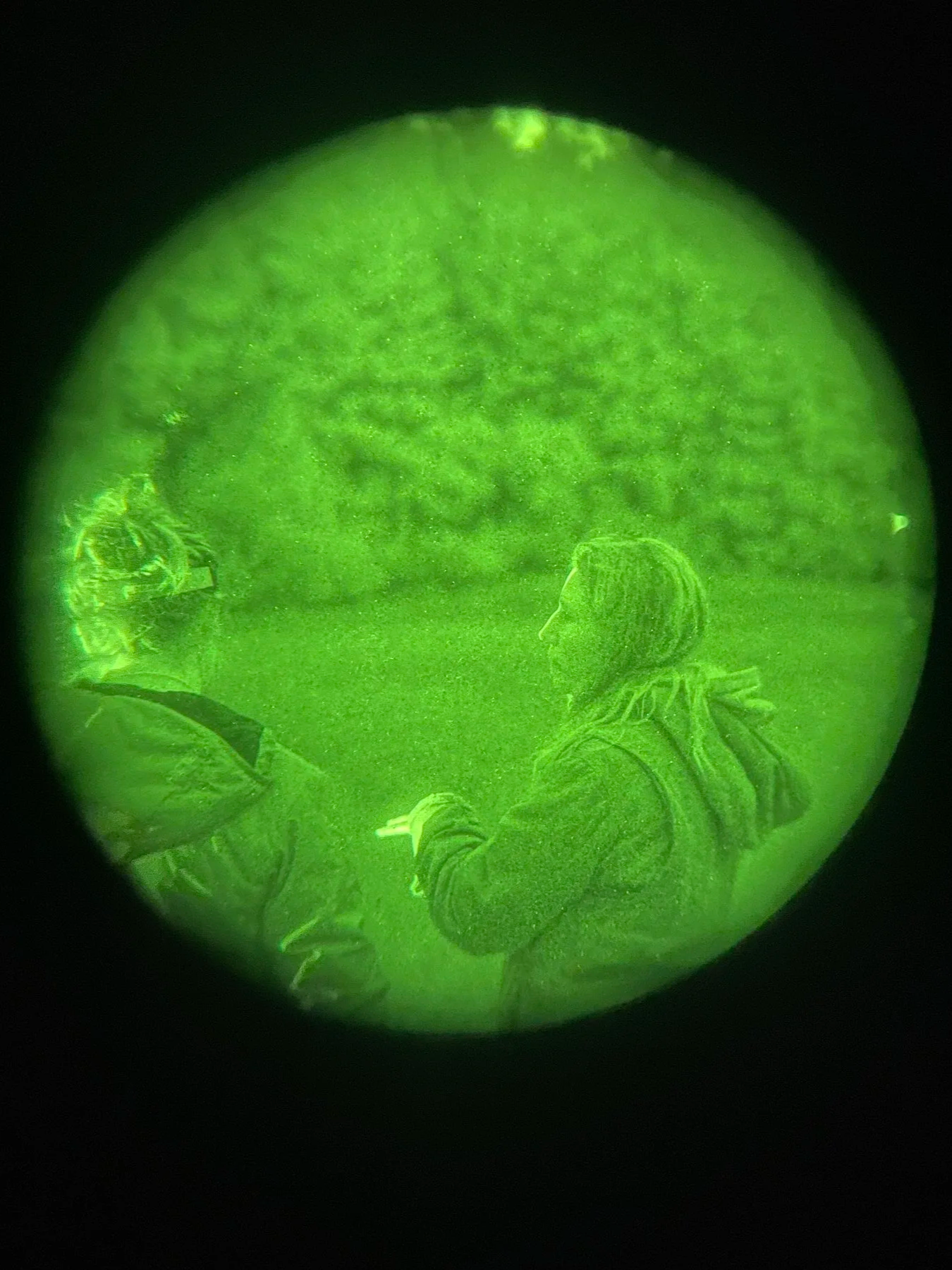
Through the lens of the goggles.
2) Bats will come for you
Healthy bats avoid people. If a bat swoops close to you at dusk, it's chasing the moths and mosquitoes gathered around you, not your head. With echolocation precise enough to snag a single insect mid-air, you or your hair (which they could detect as thin as one strand of) is not on the menu!
3) Every bat has rabies
The USGS puts rabies at less than 1% of the bat population, which is comparable to other mammals. Statistically speaking, bats are no more likely to carry rabies than mammals like foxes or raccoons. That still means you should never handle a bat with bare hands. If you find a grounded bat or have any skin contact with one, contact your local public health department or a wildlife rehabilitator.
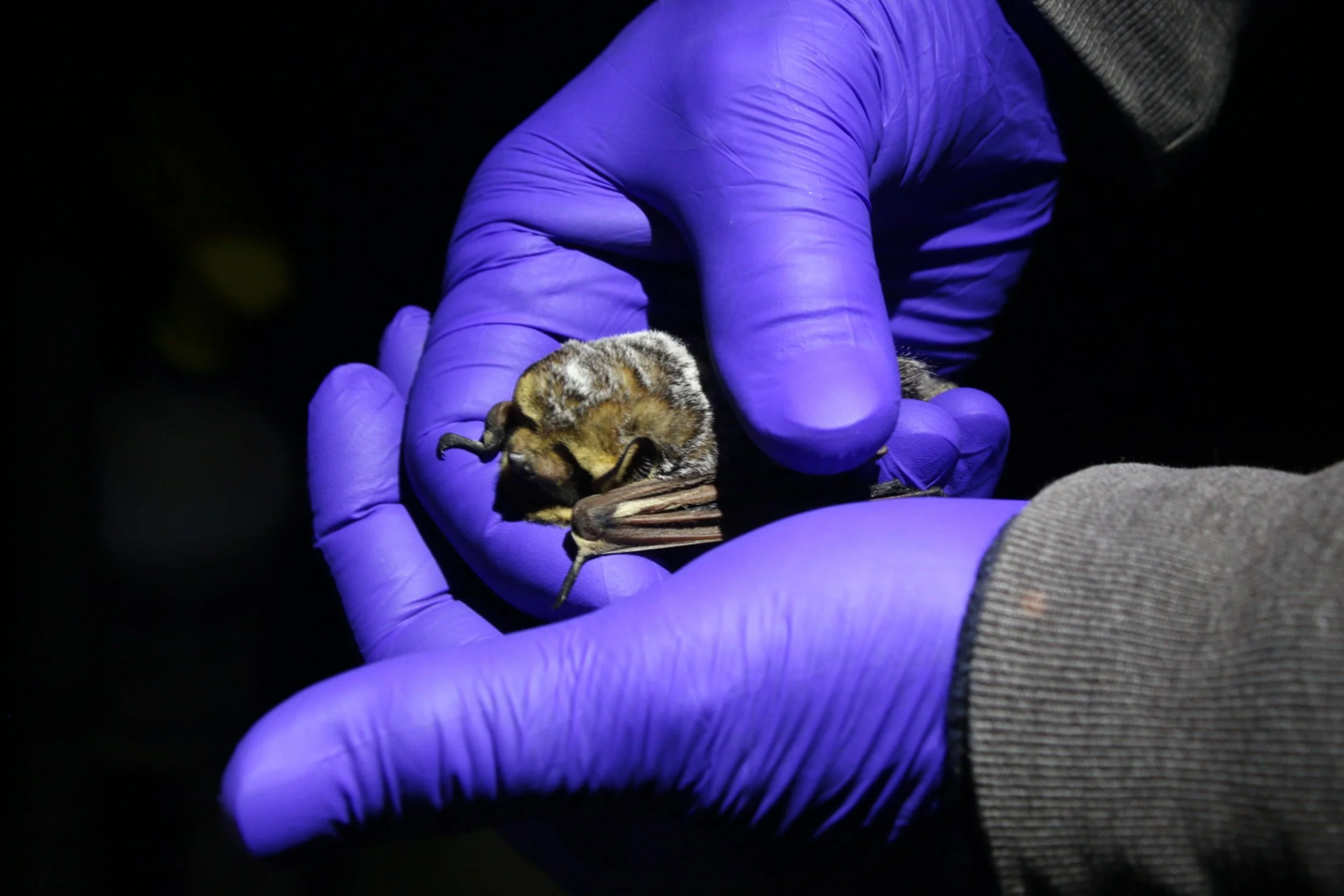
Professional, trained in proper and safe bat handling techniques, holding a Northern hoary bat (Lasiurus cinereus) for examination during workshop. Handler is wearing leather and nitrile gloves for the safety of the bat and themselves, has their pre-exposure rabies vaccination, and (not shown) is wearing an N95 mask.
4) Vampire bats seek your blood
Vampire bats are real, but they live mostly in Mexico, Central America, and South America, and the USGS notes only a single record of one in the U.S. They don't even suck blood; they make a tiny cut and lap it up, usually from livestock. California's bats are almost entirely insect-eaters and those that aren’t are omnivores, nectivores, or frugivores.
5) Bats are just flying mice
Bats aren't rodents at all; they belong to their own order of mammals, Chiroptera, meaning "hand-wing." And they break the rodent rulebook. Small mammals usually live short lives, and a mouse might live 1 to 3 years. Bats are about the same size but can live for decades. The oldest known wild bat, a Brandt's bat in Siberia, reached 41 years old. Here in Northern California, 10 to 15 years is more typical.
Treats: 8 Bat Facts, Better Than Candy
1) Bats do physics in mid-air
You know how an ambulance siren sounds higher as it races toward you and lower as it drives away? That's the Doppler effect. Bats adjust the pitch of their echolocation calls to cancel it out, constantly correcting for their own flight speed. It's real-time math, done in the dark, at full speed!
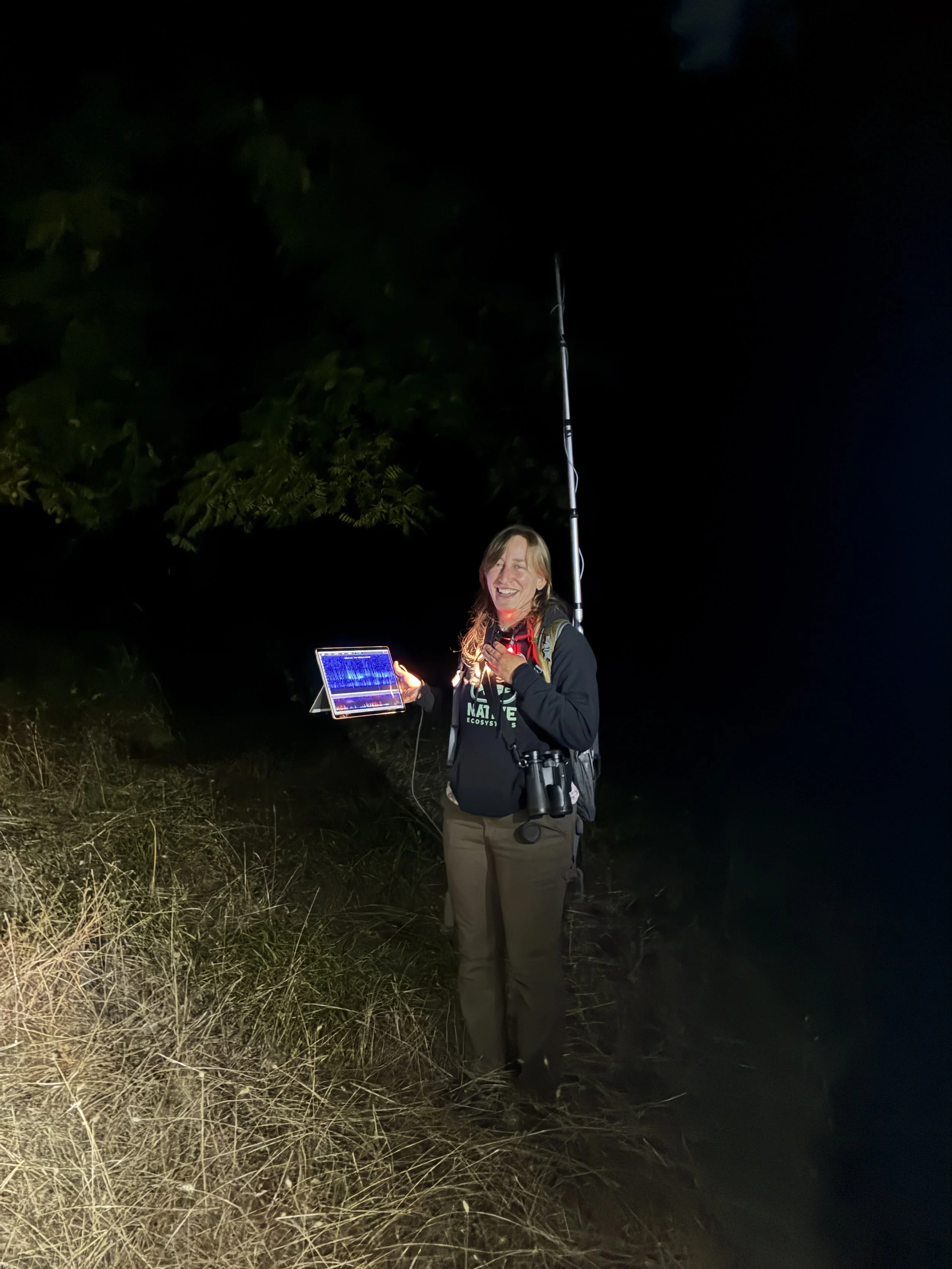
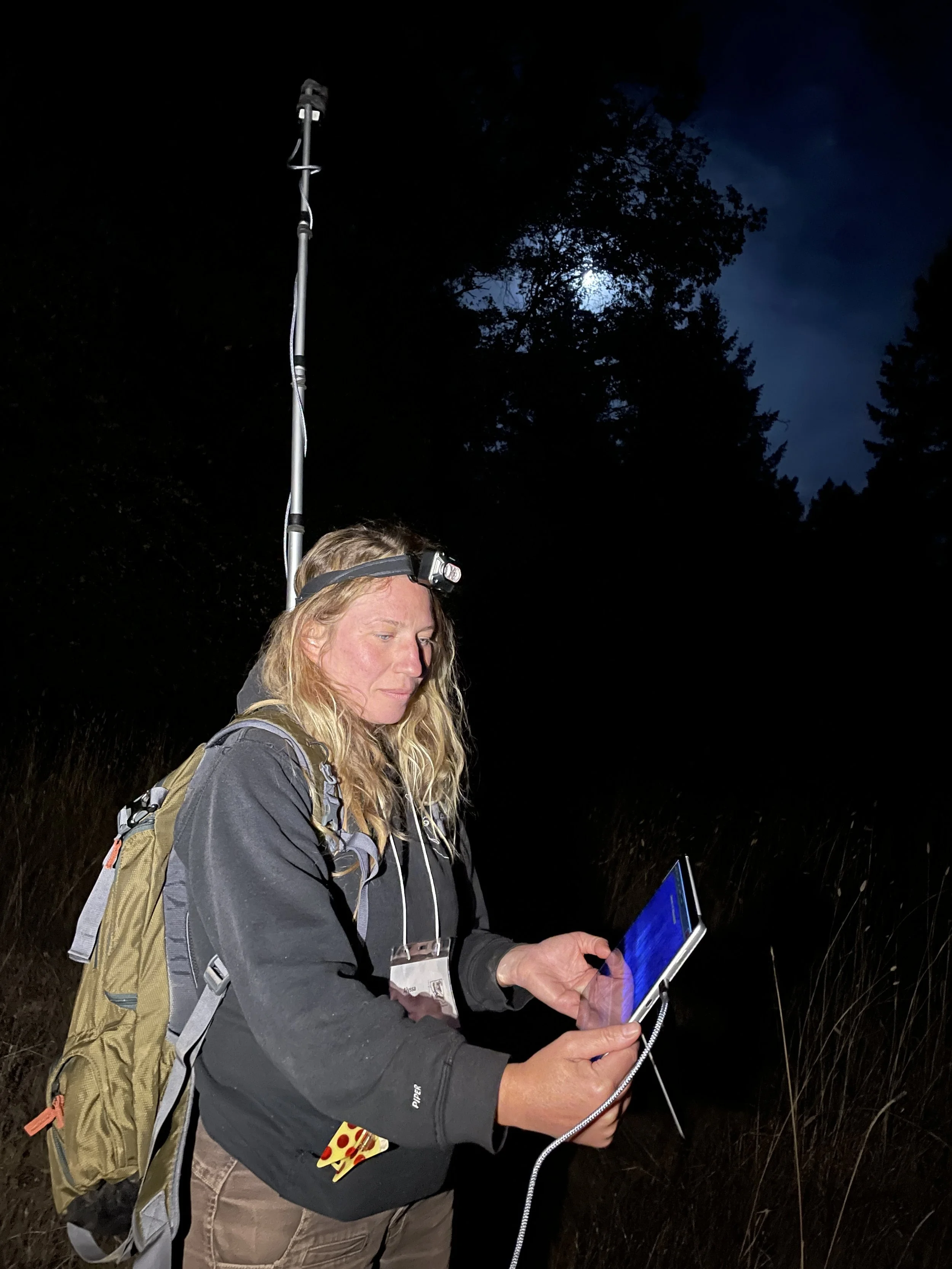
Below are images of CFC staff Janelle and Alyssa carrying a passive acoustic monitor (the rod in the backpack), with iPads showing sonograms, the calls that bats are making in real time.
2) Bats have a headlight and a spotlight
Bats use different calls for different jobs, including social calls to other bats. When they're searching for food, their calls work like a car's low beams, lighting up a wide area. Once they find a target, they switch to a "homing" call that works like a powerful, narrow headlamp, zeroing in on a single insect.
3) THE evolutionary arms race
Bats and moths have been coevolving for millions of years. Many moths can hear bats' ultrasonic calls and have developed defenses. Some drop straight out of the air the moment they hear a bat coming. Others fire back with their own clicks that jam the bat's signal so it can't lock on.
4) A bat's wing is a hand

Northern hoary bat wing examination during workshop.
If you held a bat wing up to the light, you could see the finger bones inside. The skin stretched between those fingers is incredibly elastic and heals fast, so a bat that tears its wing on a branch or a predator can get back to flying quickly. Many bats also use their wing or tail membranes like a baseball glove, scooping insects out of the air and passing them to their mouths.
5) Not all bats are built the same
California is home to 26 known bat species, and they're wonderfully different:
Flyers: Some are fast, agile acrobats. Others are slower and need open space because they can't turn on a dime.
Crawlers: Pallid bats are excellent on the ground, where they hunt crickets, scorpions, and beetles. California myotis, Yuma myotis, and the California leaf-nosed bat rely on flight and are less nimble on foot.
Night owls and early birds: Some species are most active at dusk and dawn; others come out hours after sunset.
Habitat specialists: Pallid bats forage in open grasslands, silver-haired bats in forests, little brown bats and Yuma myotis over open water, and western red bats in riparian areas.
Homebodies and travelers: Bats roost in tree cavities, foliage, rock crevices, caves, mines, and buildings. Some migrate long distances, while others make shorter seasonal moves.
Hunters: Bats have different ways of catching dinner. Some, like the pallid bat and Townsend’s big-eared bat, are “gleaners” that pluck insects right off leaves, shrubs, and the ground. Others, like the Yuma myotis, skim insects off the surface of ponds and streams. Fast flyers like the Mexican free-tailed bat snatch insects out of the air. Together, they work every level of a landscape, from the treetops down to the leaves of your crops.
Here’s why that variety is valuable to a landowner: aerial hunters take moths in flight, gleaners pick insects off leaves and stems, and skimmers patrol the water. That means pest control at every level, and it’s only the beginning of what bats can do for your land.
And yes, California has an official state bat: the pallid bat, a big-eared, pale-furred insect hunter that's at home in our oak woodlands and grasslands!
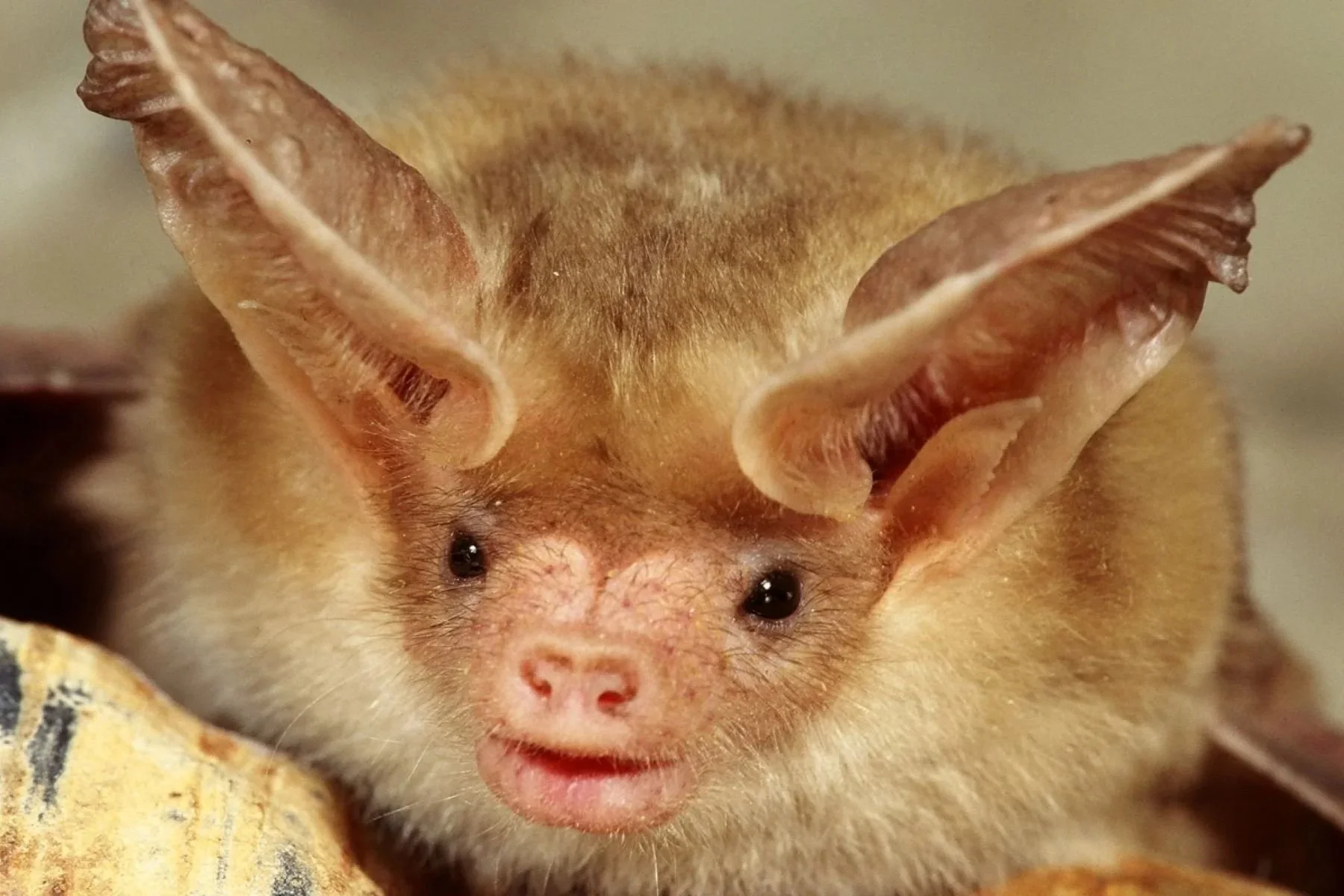
Pallid bat face up-close by the NPS.

Pallid bat eating a grasshopper by Dani Ortiz, BLM.
6) Bat moms have serious appetites
Most bats have one pup a year (hoary bats often have twins). A nursing mother may eat the equivalent of her own body weight in insects every night. That's like a 130-pound person eating 130 pounds of food a day. Even when they aren't raising young, most bats eat about a quarter of their body weight nightly.
7) Bats have best friends
Many bats are social and can recognize individuals of their own species. Behavioral studies show they have favorite roost-mates and will call out to find them, then choose to roost right next to them.
8) Bat poop sparkles
Want to know if bats are around? Look for guano (aka poop) that glitters! Bats can’t digest the tough outer parts of their insect prey, so their droppings end up full of shiny bits like moth wing scales and pieces of beetle shell. Moth-eating bats’ guano like the Mexican free-tailed bat are especially sparkly. These bats are also incredibly social; the colony under the Yolo Bypass causeway near Davis holds roughly 250,000 bats, one of the biggest bat shows in Northern California.
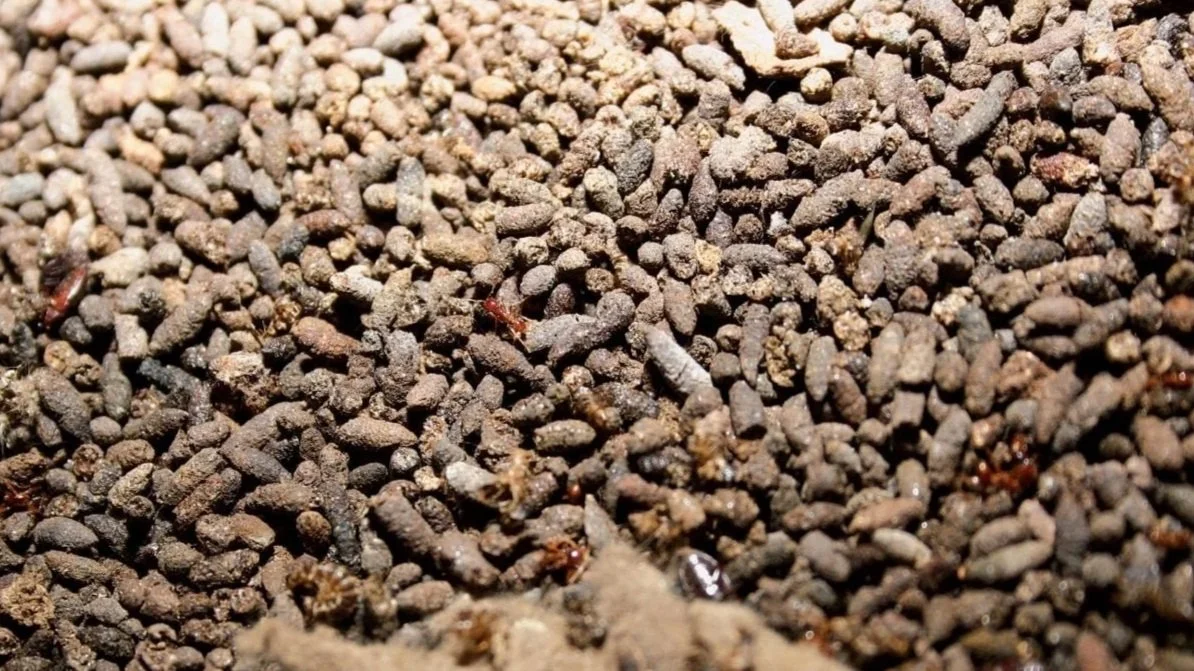
Bat guano on the floor of Bracken Cave by Andy Moore. Learn more about this natural limestone sinkhole and cave near San Antonio, Texas, that hosts the world's largest bat colony of up to 20 million Mexican free-tailed bats here.
The Treat That Keeps on Treating:
Why Farmers Should Love Bats
Here's where bats go from fascinating to downright necessary, especially for cannabis farmers and anyone else growing crops in our Northern California region.
Free, all-night pest control
By eating insects, bats save U.S. agriculture billions of dollars every year. The USGS reports estimates ranging from more than $3.7 billion to as much as $53 billion per year, and that doesn't even count the value of bats in forests or as pollinators (or account for inflation)!
For cannabis cultivators, that pest control lands right where it matters. Some of the most damaging cannabis pests, like budworms, are the caterpillars of night-flying moths. Bats hunt those moths after dark, when most other predators are asleep. Every moth a bat eats is one less moth laying eggs in your flowers.
Guano: nature's slow-release fertilizer
Bat guano is rich in nitrogen and phosphorus, nutrients that build healthy soil and feed plants. Growers have prized it as a fertilizer for centuries. When bats forage and roost on your land, they spread those nutrients for you, no bag required.
One caution: let bats deliver it on their own schedule. Disturbing roosts to collect guano can harm bat colonies, and old guano piles can carry fungal spores that are unhealthy to breathe.
Healthy bats, healthy land
Bats are a sign of a working ecosystem: clean water, native plants, healthy insect populations, and room to roost. That's the same kind of land stewardship we support every day at Cannabis for Conservation. A farm that's good for bats is usually good for salmon streams, pollinators, and the soil, too.
How to Make Your Farm or Yard Bat-Friendly
The best thing you can do for bats is protect and improve the habitat they already use. A few places to start:
Keep what's already working. Leave standing dead trees (snags) where safe, mature trees with loose bark or cavities, rock outcrops, and streamside vegetation. These are natural roosts and foraging grounds.
Plant a "prey patch" at a distance. Native plants support the moths and other night-flying insects bats eat. Most of these native insects aren’t crop pests, but it’s still smart to plant your patch at the edges of your property, along fence lines or near a creek, rather than right next to your garden or grow area. That way it keeps your crops safe while drawing bats onto your land, where they’ll hunt any pests around them too. CalFlora is a great place to find natives suited to your area.
Go easy on pesticides. Broad-spectrum sprays reduce the insects bats rely on. Let the bats do some of the work.
Keep nights dark. Bright or unshielded outdoor lights can disrupt bat foraging. Use lighting only where you need it, and point it down.
Protect water sources. Ponds, streams, and healthy riparian areas give bats both a drink and a buffet of insects.
A note on bat boxes
Bat boxes can help, but they work best as a supplement to natural habitat, never a replacement. Bats are very sensitive to temperature and design, and a box that's the wrong size, color, orientation, or placement for local species may sit empty, remain too cool (bats like it hot!), or even overheat. If you're thinking about installing one, check with a local bat expert first.
Bats in the wrong place?
If bats are roosting somewhere they're causing problems, like your attic or barn, work with a qualified bat expert. Avoid setting up exclusions on your own; it's easy to accidentally trap bats inside, and this has happened even with experienced pest control companies. Make sure whoever you hire understands bat biology.
The Bat Signal: A Call to Action
A bat, likely Yuma myotis or Little brown bat (LBB) since it's swooping so low over the water, spotted during workshop. Yuma typically forage within 20cm of the water, whereas LBB typically forage 50cm above the water.
Bats might add the perfect spooky touch to a haunted house or scary movie, but, unless you’re a moth, there’s really nothing frightening about them! They’re tireless pest controllers, soil builders, and some of the most remarkable native wildlife in California, and many of them need our help.
This Bat Week, step outside at dusk and look up. Then pick one thing from the list above to try on your land. For more ways to get involved, visit Bat Conservation International and BatWeek.org.
Happy Bat Week, and happy Halloween from all of us at Cannabis for Conservation!